


From Balancing Power to Global Gatekeeper
 Sangram Datta
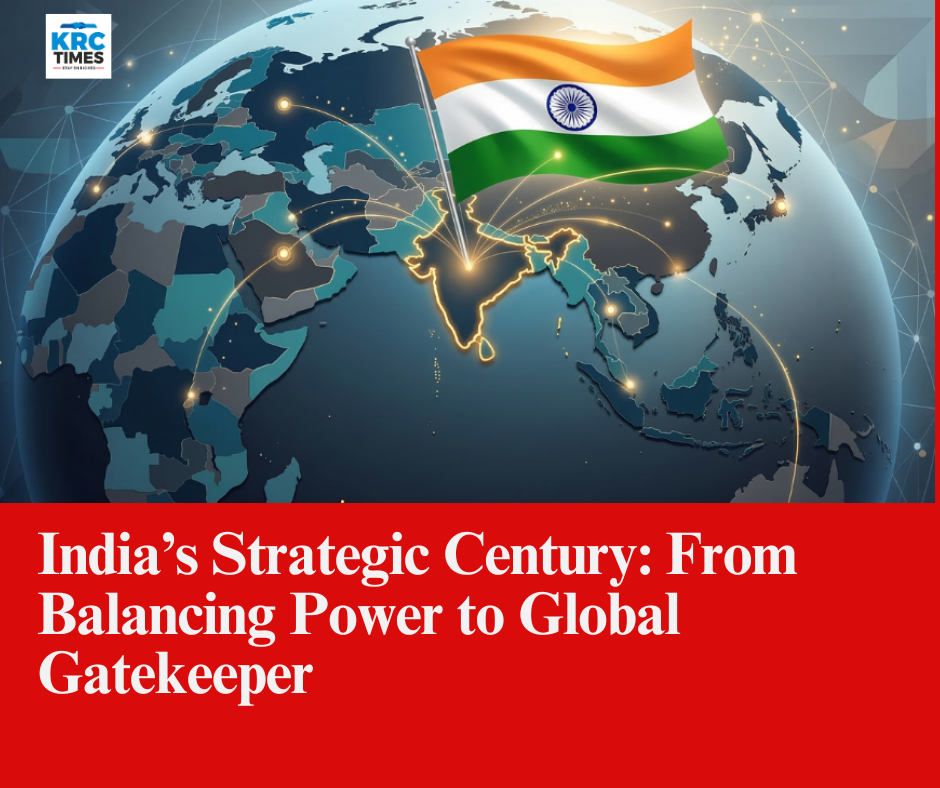
In every major geopolitical transition, there emerges at least one state capable of transforming global disorder into national advantage. In the current era of intensifying great-power rivalry, that state is increasingly becoming India.
The international system is entering a period defined by fragmentation, economic nationalism, technological competition, and strategic mistrust. The United States and China are locked in a widening contest for influence.
Russia, isolated from much of the West, is deepening ties with Beijing while simultaneously trying to preserve its own autonomy. Europe is struggling to redefine its strategic role amid security and energy crises. Yet amid this uncertainty, India has positioned itself not as a passive observer, but as one of the most agile beneficiaries of the emerging order.
What makes India’s rise particularly significant is not merely its economic growth or demographic scale. It is the sophistication of its strategic positioning.
For decades, global diplomacy largely operated through rigid alignments. Countries were expected to choose sides. The Cold War institutionalized this logic, dividing the world into competing ideological camps. But India’s contemporary foreign policy reflects a very different reality — one where strategic flexibility is more valuable than ideological loyalty.
India understands that the so-called “limitless partnership” between China and Russia is far less stable than it appears. Their cooperation is rooted in converging interests, not enduring trust. Russia remains wary of becoming economically subordinate to China, while Beijing views Moscow primarily as a strategic asset against Western pressure. These underlying contradictions create room for maneuver — and India has been quick to exploit that space.

Simultaneously, the intensifying US–China rivalry has dramatically elevated India’s geopolitical value. Washington increasingly sees New Delhi not simply as another Asian partner, but as a necessary strategic counterweight in the Indo-Pacific. This shift has translated into deeper technological cooperation, defense partnerships, semiconductor investments, and growing diplomatic coordination.
Yet India has carefully avoided becoming a formal ally in any anti-China bloc. That distinction matters.
Rather than committing itself fully to one camp, India is pursuing a sophisticated multi-alignment strategy. It continues purchasing Russian defense equipment while expanding military cooperation with the United States. It strengthens economic engagement with Western economies while preserving strategic autonomy in global institutions. It participates in forums like the Quad without abandoning its long-standing doctrine of independent decision-making.
This is no longer traditional nonalignment. It is strategic leverage at a global scale.
India’s approach toward Taiwan further illustrates this evolving doctrine. New Delhi has quietly deepened economic and technological relations with Taipei, particularly in sectors such as semiconductors and advanced manufacturing. At the same time, it avoids overt political confrontation with Beijing by maintaining formal diplomatic caution. India seeks the benefits of engagement without becoming trapped inside another power’s conflict.
The message is clear: India’s objective is not ideological confrontation. It is national advantage.
Perhaps the most remarkable transformation is psychological rather than material. India increasingly sees itself not as a state reacting to global power structures, but as one shaping them. This confidence is visible in its diplomacy, economic ambitions, technological investments, and strategic language.
The world may indeed be drifting toward a new Cold War. But India does not want to become the battleground of competing powers. It wants to become the pivotal force around which those powers calculate their strategies.
That distinction changes everything.
In the decades ahead, the defining geopolitical question may no longer be which superpower dominates the international system. The more important question could become: how much strategic access, economic partnership, and political space India is willing to provide to each competing side.
For the first time in modern history, India is not merely adapting to the global order. It is learning how to shape it.