


Rediscovering India’s Buried Civilizational Memory
 KRC TIMES Desk
Col Ashwani Kumar, MiD, VSM (Retd)
From Rajasthan’s Desert Sands to the Sacred Sangam of Prayagraj.
India is not merely a geographical entity, it is a river civilization. From the Indus to the Ganga, from the Brahmaputra to the Narmada, rivers have shaped the spiritual, cultural, economic, and philosophical life of the subcontinent for thousands of years. Among all these rivers, none has occupied a more mysterious and revered place in Indian consciousness than the Saraswati.
Mentioned repeatedly in the Rig Veda as a mighty river flowing “from the mountains to the sea,” Saraswati was regarded as the river of wisdom, learning, purity, and civilization. Yet, unlike the Ganga or Yamuna, Saraswati gradually disappeared from visible geography. Over centuries, it survived not through maps, but through scriptures, prayers, pilgrimages, folklore, and collective memory.
Today, modern science may once again be uncovering fragments of that lost river beneath the sands and soil of India.
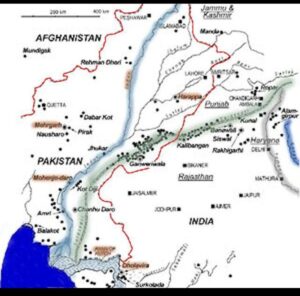
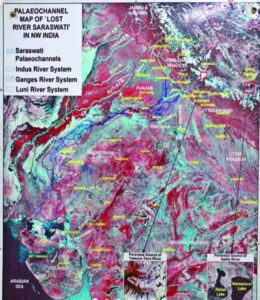
Illustration 1.
Proposed Ancient Saraswati Course through Haryana and Rajasthan.
The Ancient Memory of Saraswati.
Ancient Indian texts describe Saraswati as a powerful and sacred river sustaining early settlements and Vedic culture. Over time, however, climatic shifts, tectonic disturbances, earthquakes, and river diversions may have altered the river’s flow. Many scholars believe that tributaries once feeding Saraswati gradually shifted toward the Indus and Ganga systems, causing the river to dry, fragment, or disappear underground.
Yet Indian civilization never forgot Saraswati.
At the Triveni Sangam in Prayagraj, millions of pilgrims have for centuries worshipped the confluence of:-
Ganga, Yamuna, and the invisible Saraswati. What faith preserved in memory, science is now beginning to investigate through space-age technology.
Rajasthan Discoveries and the Rise of Satellite Investigation.
Around the late 1990s and early 2000s, the author was posted at Jaipur and was closely associated with Imagery interpretation. The author interpreted the number of imagery along with scientist of Regional Remote Sensing Centres (RRSCs), Jodhpur, where Indian scientists, including experts associated with Indian Space Research Organisation, initiated extensive studies into ancient buried river systems beneath northwestern India, using:
satellite remote sensing, Radar imagery, geomorphological analysis, Digital elevation mapping, and sediment studies,
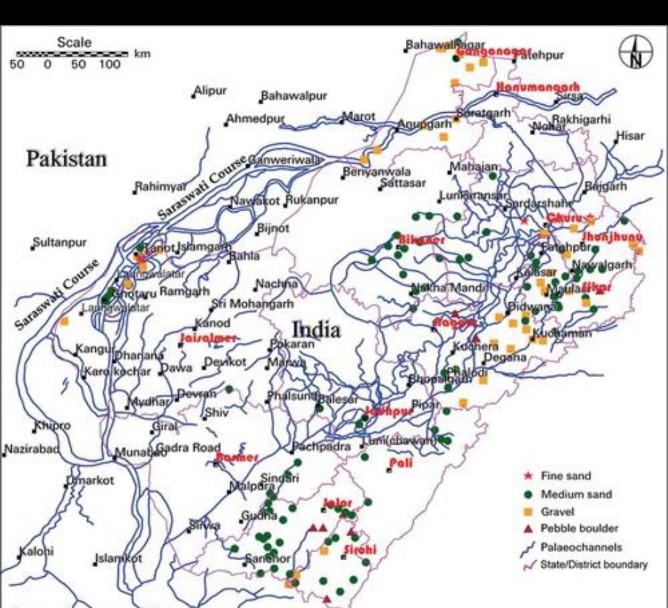
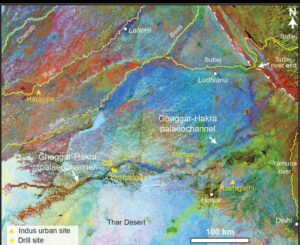
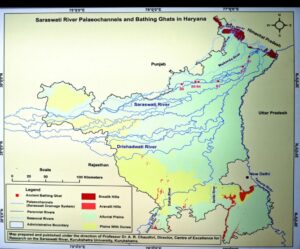
researchers identified broad underground palaeo-channels beneath Haryana, Rajasthan, and Gujarat.
These buried channels broadly followed the Ghaggar-Hakra region extending through: Adi Badri, Kurukshetra, Northern Rajasthan, Cholistan desert, and toward the Rann of Kutch.
The significance of these findings was enormous. Many Harappan and pre-Harappan settlements were discovered aligned along these dry riverbeds, suggesting that a major perennial river once sustained extensive civilization across these now-arid regions.
For the first time, satellites had begun tracing rivers lost thousands of years ago beneath desert sands.
Illustration 2
Satellite Imaging and Buried River Detection.
How Satellites Detect Ancient Rivers.
Modern satellites are far more advanced than ordinary imaging systems. Equipped with multispectral sensors, radar systems, thermal detectors, and electromagnetic instruments, they can identify hidden geological structures invisible to the human eye.
Ancient river systems leave unique underground signatures due to:
Moisture retention zones, Buried sand deposits, Sediment variation, Vegetation differences, Mineral concentrations, and thermal anomalies.
Scientists combine satellite observations with: Airborne electromagnetic surveys, Resistivity mapping, Aediment core drilling, Geographic Information Systems (GIS), and ground verification techniques.
Interestingly, many of these technologies were originally developed for: Strategic surveillance, Military reconnaissance, Border mapping, and mineral exploration.
Today, they are helping humanity rediscover ancient civilization itself.
The Prayagraj Discovery.
Recent scientific studies near the Sangam region of Prayagraj have reportedly identified a massive buried palaeo-channel beneath the earth. Using advanced geophysical surveys and subsurface investigations, scientists detected evidence of an ancient river structure beneath the plains near the confluence of Ganga and Yamuna.

Though researchers remain scientifically cautious in conclusively identifying this channel as the Vedic Saraswati, the discovery has reignited global debate and curiosity.
What makes this finding particularly significant is its possible linkage with the earlier Rajasthan palaeo-channel studies.
Linking Rajasthan and Prayagraj
Several geological theories suggest that in very ancient times the Yamuna may not always have flowed exclusively eastward toward the Ganga as it does today. Due to tectonic shifts, seismic disturbances, climatic changes, and river-capture phenomena over thousands of years, portions of the Yamuna system may once have contributed waters toward the Saraswati basin before changing course.
This theory creates a possible scientific linkage between:
The buried river channels identified in Rajasthan and Haryana,
and the newly detected palaeo-channel beneath Prayagraj.
Scientists are not claiming that one continuous underground river presently flows from Rajasthan to Prayagraj. Rather, both regions may preserve surviving fragments of a much older interconnected Himalayan-fed river network that evolved and fragmented over millennia.
In simplified form, the possible ancient hydrological sequence may have been:
Himalayan origin – Haryana – Rajasthan – tectonic shifts and river diversion – Eastern migration toward Ganga basin – surviving buried channels near Prayagraj
Remarkably, this interpretation resonates with the ancient Indian concept of Saraswati becoming “gupt” – hidden beneath the earth.
Illustration 3
Conceptual Linkage between Rajasthan Palaeo-Channels and Prayagraj.
Spiritual and Civilizational Importance. The importance of Saraswati extends far beyond geology. For millions of Indians, Saraswati symbolizes: Wisdom, Knowledge, Spiritual purity, and civilizational continuity.
Even after disappearing from visible geography, the river remained alive in: Sacred literature, Rituals, Pilgrimage traditions, and collective faith.
The recent scientific findings therefore hold profound emotional and cultural significance. Many people view them as a rare convergence between ancient memory and modern science.
Importantly, science and spirituality need not always exist in conflict. Ancient civilizations often preserved memories of real geographical and environmental events long before scientific instruments emerged.
What satellites are investigating today may well be echoes of memories preserved for thousands of years in India’s civilizational consciousness.
Scientific and Strategic Importance.
(a) The rediscovery of buried river systems has major implications for the future.
(i) Groundwater and Water Security
(ii) Ancient riverbeds often contain valuable underground water reserves. Mapping such channels may assist future water-resource planning in a water-stressed world.
(iii) Archaeological Exploration
(b) Buried channels may help locate undiscovered settlements connected with Harappan and pre-Harappan civilization.
(i) Climate Research. Ancient rivers preserve evidence regarding:
Monsoon history, Climate change, Tectonic movement, and environmental evolution.
(c) Strategic and Technological Advancement
The same technologies used for: Defence reconnaissance, Terrain analysis,
and strategic mapping are now helping reconstruct ancient geography and civilization.
This represents a remarkable transformation of science from instruments of surveillance into instruments of historical rediscovery.
A Balanced Scientific Perspective.

Despite growing excitement, scientific caution remains necessary.
Researchers have identified extensive buried palaeo-channels beneath parts of Rajasthan and near Prayagraj. However, definitive proof that these channels are exactly the same Saraswati described in Vedic literature remains under investigation.
What science has clearly established is this: Ancient river systems once flowed through regions now dry, fragmented, or buried beneath the earth.
Whether these fully correspond to the Saraswati of the Vedas continues to be debated by:
Geologists, Archaeologists, Historians, Hydrologists, and scholars of ancient Indian literature.
Yet even this much is extraordinary.
Modern technology has confirmed that beneath the deserts of Rajasthan and the sacred plains of Prayagraj lie traces of forgotten rivers that once shaped human civilization.
To conclude, the story of Saraswati is no longer confined only to mythology or faith. It has become a meeting point of:
Science, Satellite technology, Archaeology, Geology, History, Spirituality, and civilizational memory.
From the buried sands of Rajasthan to the sacred confluence at Prayagraj, a larger picture is gradually emerging, one suggesting that ancient India possessed a far more dynamic and interconnected river system than previously understood.
Perhaps the greatest lesson of this rediscovery is that civilizations never entirely lose their memory. Sometimes memories survive not in monuments, but in traditions, sacred geography, and the faith of generations.
And centuries later, satellites orbiting silently above the earth begin tracing those memories once again beneath the sands and soil of India.
Author’s Note
The subject of Saraswati has long remained a fascinating intersection of history, geography, science, and civilizational memory. Having spent over two decades in the field of imagery interpretation and terrain analysis during military service, the author has closely observed the evolution of satellite remote sensing and geospatial studies in India.

The author had earlier worked on the dunal configuration of the Cholistan and Thar desert sectors and studied possible palaeo-channel signatures across Rajasthan. The recent scientific findings relating to buried river systems near Prayagraj and Rajasthan appear to support many of those earlier observations and interpretations.
This article is an effort to examine the emerging convergence between modern technology, geological research, and India’s ancient civilizational memory.
About the Author.
Col Ashwani Kumar is a retired military professional, defence analyst, writer, and researcher with extensive experience in imagery interpretation, terrain analysis, and strategic studies. He has written on defence, Himalayan regions, Indian civilization, spirituality, and cultural heritage. His earlier analytical work on the Cholistan -Thar desert geomorphology and possible Saraswati signatures in Rajasthan contributed to discussions on ancient river systems in northwestern India
Disclaimer:
This article is based on open-source information, publicly available scientific studies, media reports, satellite imagery references, historical literature, and civilizational traditions. The views expressed are personal and analytical in nature.
All maps, images, sketches, and illustrations referred to are sourced from publicly available open platforms and remain the property of their respective owners. They are used strictly for educational, academic, and illustrative purposes.