


The bench passed these important directions after hearing a batch of pleas, as it said the SIT must conclude the investigation expeditiously and take it to its logical conclusion
 KRC TIMES National Bureau
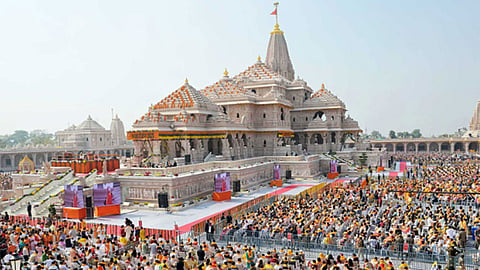
NEW DELHI | The Supreme Court on Monday directed the court-appointed Special Investigation Team (SIT) probing the alleged embezzlement of donations at the Ram temple in Ayodhya to expedite its investigation and bring it to a logical conclusion.
A bench of Chief Justice Surya Kant and Justices Joymalya Bagchi and V Mohana directed the SIT to file its status report in a sealed cover on the progress made in the investigation into the alleged donation theft case. The court, in its order, also asked the SIT to objectively consider any suggestions made by the different litigants before the court for qualitative improvement of the investigation and its transparency.
The bench passed these important directions after hearing a batch of pleas, as it said the SIT must conclude the investigation expeditiously and take it to its logical conclusion. The batch of petitions sought an inquiry into the allegations that donations made by devotees for the temple construction were not properly accounted for. The petitioners argued that, given the scale of public donations and the religious importance of the project, transparency was essential.
The court noted that the SIT had already been constituted to look into the matter. It refrained from giving further directions on the scope of the probe but stressed that the investigation should not be delayed. The Shri Ram Janmabhoomi Teerth Kshetra Trust, which is overseeing the construction of the Ram temple, has earlier denied any irregularities and said all donations are duly recorded.
The matter will now be taken up again by the top court after the SIT files its report before it. According to the petition, there were claims of improper accounting of devotees’ contributions. The petitioners sought a court monitored probe to ensure accountability.
The court did not expand the terms of reference but made it clear that the investigation should be completed at the earliest and the findings placed before it. The PIL (Public Interest Litigation) filed by advocates Narendra Kumar Goswami, Ajay Kumar Rai and Dinesh Kumar Yadav and others sought a court monitored probe by the CBI and other agencies into the alleged misappropriation of donation funds collected at the Ram Mandir.

Send your resume:
biswa@jigyasu.co.in
krcfoundation@gmail.com
The plea also said that there was urgency in the case, as physical, electronic, digital, banking and inventory records relating to donations and offerings at Shri Ram Janmabhoomi Mandir, Ayodhya, are preserved.
“CCTV/DVR/NVR data, QR/UPI/payment gateway logs, hundi registers, counting sheets, bank records, vault access records, inventory records and all connected material are not destroyed, overwritten, altered, moved, substituted or tampered with. The available CCTV/DVR/NVR footage and digital payment records are forensically copied/hash sealed. The SIT status/preliminary report, if submitted, is kept available in sealed cover before this Court,” the plea added.
The petitioners also submitted that preservation of records would not prejudice any respondent. “It will not declare guilt. It will not interfere with any religious affair. It will not obstruct temple administration, worship, darshan, rituals, sewa or puja paddhati. It will only preserve the subject matter of justice,” the petition stated.
The petitioners further added that public faith is not weakened by transparency; it is strengthened by it. A matter concerning donations and offerings made by millions of devotees cannot be treated as an ordinary private accounting dispute. It concerns constitutional morality, public accountability, fiduciary responsibility and the rule of law in the secular administration of sacred public offerings.
Goswami also stressed that the petition was confined strictly to secular aspects such as receipt, custody, counting, accounting, audit, digital trail, inventory control, CCTV preservation, QR/UPI verification, bank reconciliation and public accountability of donations and offerings.
“It does not seek to touch religious practices protected under Articles 25 and 26 of the Constitution of India,” the plea stated.

