


Faith, Culture, and Identity in a Festival Beyond Borders
 KRC TIMES NE Desk
SIVASHIS BHATTACHARJEE
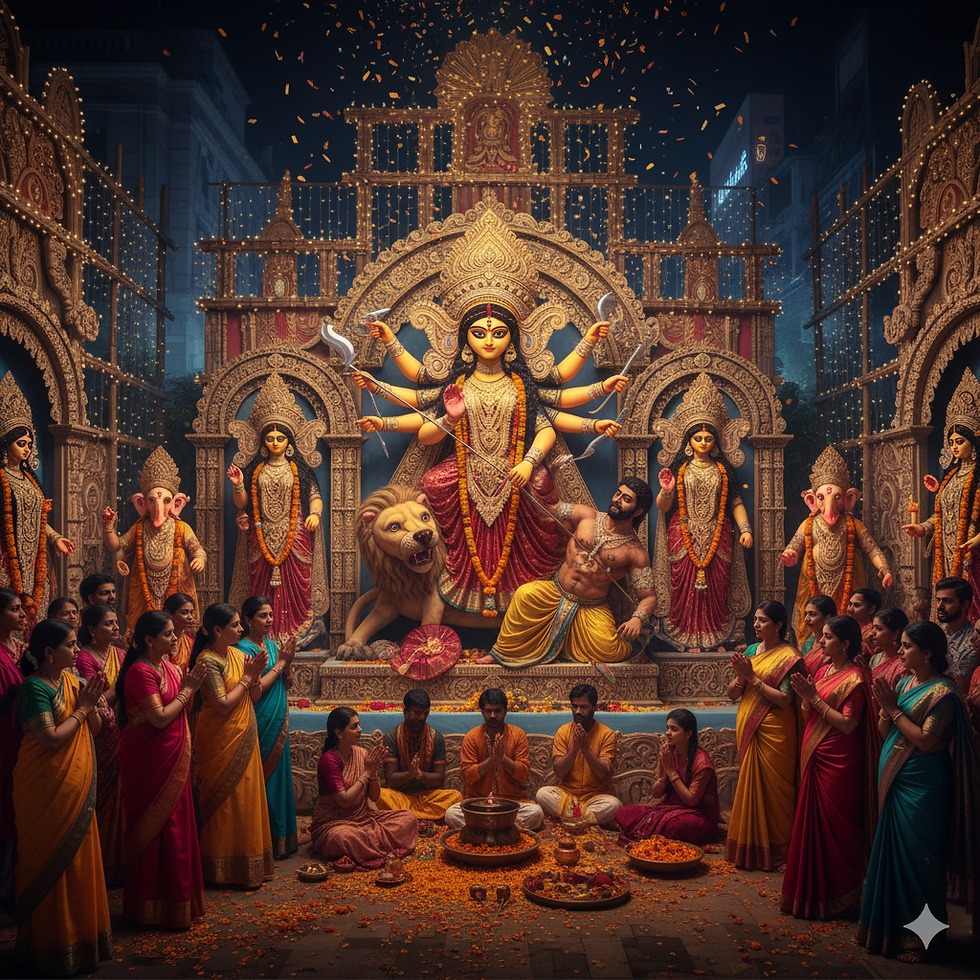
When the rhythmic beats of the dhak echo across bamboo pandals, and the fragrance of incense mingles with the heady scent of shiuli blossoms, one knows that the most anticipated festival of the year has arrived. Durga Puja, once seen as a largely Bengali religious celebration, has today become a cultural phenomenon that binds together communities across the Northeast.
In states as diverse as Assam, Tripura, Manipur, Meghalaya, Nagaland, Arunachal Pradesh, and Mizoram, the arrival of Goddess Durga is not just about devotion-it is about his- tory, identity, artistic expression, and the weav- ing of social harmony.
Durga Puja in the Northeast is not merely transplanted tradition from Bengal; it is a festi- val that has taken root in local soils, absorbing regional flavors and becoming an integral part of the region’s cultural calendar. Understand- ing its significance here requires looking at multiple layers-historical migration, colonial legacies, syncretic practices, artistic expres- sions, and its present role as a platform for unity in a region often fractured by identity politics.
The spread of Durga Puja into the Northeast can be traced back to the late 18th and early 19th centuries, when Bengali zamindars, traders, and officials under colonial administration migrated to states such as Assam and Tripura.
The earliest recorded Durga Puja in Assam dates back to the 18th century during the reign of the Ahom kings, who welcomed Hindu rituals into their courtly life. Tripura’s royal family, tracing descent from the Manikya dynasty, also patronized Durga Puja as part of their court rituals, merging tribal customs with Hindu worship.
With the coming of the British, large numbers of Bengalis settled in Guwahati, Shillong, Agartala, Silchar, and Dibrugarh, carrying with them the tradition of Durga Puja. But over time, the festival expanded beyond Bengali neighborhoods. Assamese Hindus embraced it alongside their own traditions of Namghar-centered Vaishnavite practices.
In Manipur, where Vaishnavism had flourished since the 18th century, Durga Puja slowly found a place alongside Manipuri Ras Lila festivities. In Shillong, once the capital of undivided Assam, Durga Puja became one of the biggest public events, cutting across ethnic and religious divides.
Thus, the roots of the festival in the Northeast lie in cultural migration and royal patronage-but its flourishing owes itself to the capacity of the region’s communities to adapt and celebrate diversity. One of the striking features of Durga Puja in the Northeast is its ability to act as a bridge between communities. While the ritualistic core-invocation of Goddess Durga slaying Mahishasura-remains the same, the surrounding cultural activities often reflect local traditions.
In Assam, pandals are adorned with motifs of Ahom, Bodo, and Mising art forms. Bamboo craft, an indigenous skill of the region, is central to pandal construction. In Tripura, tribal dance troupes perform during Puja evenings, bringing Kokborok songs into the celebration space. In Manipur, Durga idols are often accompanied by Manipuri Shankirtan performances, blend- ing Vaishnavite devotional music with Puja rituals.

In Shillong and other parts of Meghalaya, where Christians form the majority, Durga Puja has nevertheless become a citywide cultural festival. Khasi, Jaintia, and Garo youth actively participate in pandal competitions, food stalls, and cultural programs, turning the Puja into a shared urban carnival. The syncretism is not accidental. In a region where ethnic and linguistic divides have often sparked conflict, Durga Puja has come to symbolize a safe space of cultural co-existence.
It is common to see a Khasi artisan designing a pandal in Shillong, a Bodo drummer playing for a Puja procession in Assam, or a tribal craftsman carving intricate bamboo frames for idols in Tripura. Much like Kolkata, the cities and towns of the Northeast have turned Durga Puja into an art festival. Guwahati’s Beltola, Silpukhuri, and Pandu pandals compete with each other to showcase innovative themes.
Themes range from replicas of famous temples to contemporary social messages such as environmental conservation or women’s empowerment. In recent years, Guwahati pandals have recreated the Kamakhya temple, Majuli satras, and even bamboo forests to highlight local heritage. Agartala’s Puja pandals often showcase Tripura’s indigenous traditions-such as replicas of bamboo huts of the Reang tribe or murals depicting Jhum cultivation.
In Shillong, creativity runs wild, with pandals themed around everything from global landmarks to Khasi folklore. The idol-making traditions too reflect local flavor. While traditional clay idols continue to be brought from West Bengal, many local artisans now craft idols incorporating bamboo, paper, and eco-friendly materials.
In Dibrugarh, artisans experiment with Assamese silk and weaving motifs, while in Tripura, tribal jewelry sometimes adorns the goddess. The rise of “green Puja” initiatives-banning plastic, using natural dyes, and ensuring eco-friendly immersion-is also notable across the region, reflecting growing environmental consciousness.
For the people of the Northeast, Durga Puja is more than worship-it is a celebration of community. It is a time when relatives travel back to their hometowns, when migrant students and workers reunite with their families, and when neighborhoods buzz with festive energy. Evenings are filled with cultural programs-folk songs, Bihu dances, Rabindra Sangeet, rock concerts, and drama performances.
Food stalls offering Assamese pithas, Manipuri singju, Tripuri mui borok dishes, alongside Bengali sweets like rosogolla and sandesh, turn pandal premises into gastronomic fairs. The Puja also generates seasonal employment. Thousands of artisans, electricians, dec- orators, dhakis (drummers), and small traders depend on Puja for income.
For women’s groups and self-help collectives, Puja fairs are an oppor- tunity to showcase handicrafts and homemade snacks. Moreover, Durga Puja is deeply tied to the nostalgia of urban life in the Northeast. For those who have migrated to Delhi, Bengaluru, or abroad, returning home during Puja is akin to reconnecting with their roots.
Social media too amplifies the sense of community, with live streams of Guwahati or Agartala pandals watched by diasporic Assamese and Bengali families worldwide. Durga Puja has also acquired political significance in the Northeast. State governments, particularly in Assam and Tripura, extend grants and support to Puja committees, recognizing the festival’s role in generating tourism and showcasing cultural vibrancy.
Politicians often inaugurate pandals, seeing it as an opportunity to connect with constituents. In Assam, the festival overlaps with the state’s identity politics. While Vaishnavism remains central to Assamese culture, Durga Puja has been embraced as a parallel symbol of Assamese-Hindu identity, especially in urban centers.
In Tripura, where tribal and Bengali populations have at times been polarized, Puja becomes a stage where both communities par- ticipate, reinforcing the idea of shared belong- ing. On a broader scale, Durga Puja in the Northeast also represents a cultural assertion of the region within the Indian nation-state.
Just as Kolkata’s Puja has gained UNESCO recognition as intangible cultural heritage, Northeastern states are increasingly projecting their Puja celebrations as symbols of inclusivity and creativity to the national stage. Yet, the Puja is not without challenges. In areas with fragile ethnic relations, Puja celebrations sometimes face opposition or restrictions.
In Meghalaya, for instance, periodic clashes between Bengali settlers and Khasi groups occasionally overshadow the otherwise joyous Puja mood. In Tripura, political violence in the past occasionally disrupted the festival. Commercialization is another concern. Critics argue that the essence of devotion is being overshadowed by corporate sponsorship, flashy competitions, and excessive spending on pan- dals.

The rising cost of organizing Puja also side- lines smaller community groups who cannot compete with big-budget pandals. Environmental concerns too loom large. Idol immersion in rivers like the Brahmaputra has raised alarm over pollution.
While eco-friendly initiatives are gaining momentum, ensuring their widespread adoption remains a challenge Despite these challenges, Durga Puja in the Northeast continues to thrive because it is a living tradition-adaptable, resilient, and inclu- sive. Its significance lies not only in the worship of Goddess Durga but in what she symbolizes: the victory of good over evil, the triumph of resilience over adversity, and the power of unity amidst diversity.
In a region often portrayed as conflict-ridden, Durga Puja tells another story-that of shared celebration, intermingling of cultures, and the building of social harmony. For the youth of the Northeast, the festival is as much about music nights, food festivals, and Instagram-worthy pandals as it is about heritage. For elders, it is about nostalgia and continuity.
For artisans and workers, it is about livelihood. And for the faithful, it is about devotion to the goddess who embodies strength and protection. Durga Puja in Northeast India is far more than a borrowed tradition from Bengal.
It is a regional cultural phenomenon that has adapted to local histories, absorbed indigenous expressions, and become a unifying thread in the diverse social fabric of the Northeast. Whether in Guwahati’s grand pandals, Tripura’s tribal-infused celebrations, Shillong’s cosmopolitan carnival, or the quieter Pujas of Manipur and Nagaland, the festival is a testament to the region’s ability to celebrate diversity within unity.
As the dhak beats grow louder and the goddess is welcomed once more this year, the Northeast does not just bow to Durga as a deity-it celebrates her as a symbol of shared culture, resilience, and hope. In doing so, it reminds India that the spirit of Durga Puja is not confined to Bengal’s borders but is alive in the hills, plains, and valleys of the Northeast, where faith and festivity continue to weave communities together